• Events & Webinars
  • Resources
    • Blog
    • Case Studies
    • News
    • Newsletter
    • Infographics
    • Papers
    • Posters
    • Video
  • Careers
    • Careers at HBS
    • Open Positions
    • Student Opportunities
  • About HBS
    • About Us
    • Leadership
    • Locations
    • Partners
    • Green Initiatives
  • Events & Webinars
  • Resources
    • Blog
    • Case Studies
    • News
    • Newsletter
    • Infographics
    • Papers
    • Posters
    • Video
  • Careers
    • Careers at HBS
    • Open Positions
    • Student Opportunities
  • About HBS
    • About Us
    • Leadership
    • Locations
    • Partners
    • Green Initiatives
HBS logo
HBS Logo
  • Infrastructure
    • CLOUD

      • Cloud Solutions
      • Public Cloud
      • Hybrid Cloud
      • Infrastructure as a Service
      • Cloud Security Solutions
      • Backup, Replication and Disaster Recovery
      • HBS Cloud Hosting Services

      DATA CENTER

      • Data Center Solutions
      • Traditional Data Center
      • Hyperconverged
      • Colocation
      • Directory Services
      • Cloud Email and Calendar Solutions

      NETWORK AND ACCESS

      • Network Infrastructure
      • Enterprise Mobility
      • Wireless Solutions
      • SD-WAN
      • Structured Cabling
      • Staff Augmentation
  • Managed Services
    • MANAGED ONE

      • Managed One Overview
      • Managed Backup and Disaster Recovery
      • Managed Firewall
      • Managed SaaS Security


      • Managed HaaS and SaaS
      • Managed IT Help Desk
      • Managed Network and Server Monitoring
      • Managed Email and Collaboration Security

      HBS + PARTNER SOLUTIONS

      • HBS Secure with Verkada
      • HBS Collaborate with Webex
      • Managed XDR
      HBS Managed One Megamenu Graphic
  • Modern Workplace
    • MICROSOFT

      • Microsoft Licensing Management
      • Microsoft Modern Workplace
      • Microsoft Fabric


      • Dynamics 365 Business Central
      • Dynamics 365
      • Dynamics GP

      COLLABORATION

      • Audio Visual
      • Unified Communication Solutions
      • HBS Collaborate with Webex
  • Professional Services
    • ADVISORY

      • Virtual CISO
      • Virtual CIO
      • Project Management
      • IT Business Consulting

      ENGINEERING SERVICES

      • Staff Augmentation

      AI & ANALYTICS

      • Artificial Intelligence
      • AI Advance
      • AI Predict
      • AI Assist
      • Data Management and Analytics
      • Microsoft Fabric

      APPLICATION INNOVATION

      • Website Development
      • Application Development

      DOCUMENT MANAGEMENT

      • Document Management Services
      • Document and Check Scanners
  • Security
    • CYBERSECURITY

      • Managed XDR
      • Penetration Testing
      • Vulnerability Scanning
      • Email Security Services
      • Digital Forensics and Incident Response
      • Backup, Replication and Disaster Recovery
      • Firewalls
      • Cloud Security Solutions


      • Virtual CISO
      • Virtual Security Team
      • Virtual Security Engineer
      • Cybersecurity Risk Assessment
      • Governance and Compliance
      • SOC 2
      • CMMC
      • Managed Security Awareness Training

      PHYSICAL SECURITY

      • Security Solutions
      • HBS Secure with Verkada
      Cybersecurity Risk Assessment Megamenu Graphic
  • Search
Contact Us
Blog

The Cornerstone of Success: Cultivating Organizational Resilience

  • Written by: Ryan Mosher
  • November 16, 2023
The image shows a close-up of a person's hand pushing a red domino, which stands out among a sequence of white dominoes set on a wooden surface. The action captures the moment before the red domino is likely to fall and initiate a chain reaction with the other dominoes. The person is wearing a white shirt, and only their hand is visible. The background is neutral and out of focus, emphasizing the dominoes and the action.

In a world where data is as valuable as currency, the resilience of an organization's data protection and recovery capabilities is not just an IT concern but a cornerstone of business survival and continuity.

Nearly 70% of small businesses close within a year of significant data loss — this highlights an existential threat that modern companies face. It is a stark reminder that organizational resilience — maintaining business continuity amid various disruptions — is non-negotiable.

The Cost of Downtime

Whether a natural, physical, or technology-based disaster, any disruption in an organization's day-to-day or even hour-to-hour operations can prove costly.

IT leaders estimate downtime costs $88,000 per hour, with only 2% of businesses able to fully recover in less than 60 minutes. Additionally, a prolonged data loss can cause severe—often irreparable—damage to an organization’s reputation.

$88k

Downtime costs $88,000 per hour on average.

2%

Only 2% of businesses can fully recover in less than 60 minutes.

96%

96% of businesses with mature organizational resilience fully recover operations.

With more than half of companies experiencing lengthy downtime due to data disruptions, the urgency for robust business resilience becomes clear.

Understanding Organizational Resilience

Organizational resilience is more than a simple crisis management plan. It’s a comprehensive approach that encompasses the readiness to deal with unexpected events and the agility to bounce back stronger than before. At its core,organizational resiliency means fostering a culture that is not only reactive in the face of challenges but also proactive in anticipating potential risks and vulnerabilities. Resilience combines both physical and cyber defenses in an effort to prevent possible attacks, as well as respond to active threats.
FREE DOWNLOAD Get decision-makers on board with cybersecurity. Successful cybersecurity requires executive buy-in. Download our guide for tips and talking points to make your strongest pitch.  

Five Pillars of Business Resiliency

To achieve a high level of organizational resilience, companies must build on several key pillars:

1. Risk Assessment and Planning:

Identifying potential threats and assessing their impact on the business is the first step toward resilience. This involves conducting thorough business impact analyses (BIAs) to understand the critical work processes and the dependencies that keep the organization running.

2. Financial Preparedness:

A crucial aspect discussed in the context of business resiliency is understanding an organization’s maximum tolerable loss (MTL). This is the financial threshold beyond which a company’s survival is at risk. Knowing your MTL is a pivotal part of financial planning.

3. Strategic Response Framework:

A well-defined incident response plan that outlines roles and responsibilities is essential. However, it should be part of a broader strategy that includes disaster recovery and business continuity plans, ensuring that the organization can maintain or quickly resume critical functions.

4. Recovery Objectives Alignment:

Aligning recovery time objectives (RTOs) and recovery point objectives (RPOs) between business expectations and IT capabilities is vital. Organizations must balance the desire for rapid recovery with the practicalities of technical capabilities and the financial implications of such readiness.

5. Communication and Collaboration:

Effective communication and a collaborative culture are instrumental in navigating crises. Bringing together diverse teams to contribute to recovery plans, including personnel from across your entire organization, ensures a comprehensive and practical approach.

Resiliency Capability Maturity Model

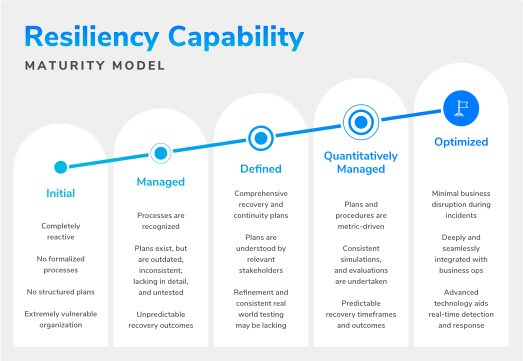
The journey to organizational resilience takes time and effort, and many organizations never reach full resilience maturity. However, for those organizations that do, the ROI is immense. 96% of businesses with mature organizational resilience FULLY recover operations following a disruption. So, how do organizations reach this level of resilience? Initially, organizations respond to disruptions as they occur without prior planning or preparedness. Gradually, businesses start to plan for potential disruptions, developing processes and strategies to mitigate risk. Finally, the mature organization proactively manages risks with a clear understanding of its risk appetite and a strategy tailored to its unique operational landscape.
Never an H3

outsourced project management

H3 Example

By elevating the approach from reactive to proactive, organizations can do much more than survive disruptions. They can leverage these challenges as opportunities for growth and improvement.

The Scorecard for Organizational Resilience

Assessing resilience is like preparing a scorecard.

It is about understanding the impact of disruptions on financials, customers, employees, and compliance. Scoring each domain helps prioritize recovery efforts and resource allocation during a disruption.

These scorecards are crucial for any organization’s resilience before, during, and after a disruption to business operations. They also help craft a blueprint for action during and after a crisis, ensuring that the most critical business functions can be restored with minimal delay.

The Resiliency Ecosystem

Resiliency is not just disaster recovery. It’s an ecosystem that includes preparing for risks with a comprehensive threat analysis, understanding the financial implications through concepts like maximum tolerable loss, and aligning recovery objectives with business expectations.

Organizational resilience is a process that is constantly evolving. Business continuity, disaster recovery, incident response, and business impact analysis should be active verbs and not static nouns. Mature resilience involves continuous action — updating playbooks, researching new tools, and allocating resources — to keep the organization ahead of potential threats. This ecosystem also fosters a culture where every level of the organization is security-aware and risk-conscious, and communication channels are clear and open.

In a strong and resilient organization, that resiliency culture starts at the top. Executive support is crucial for any organization to reach mature resilience — budgets, resources, and priority are given to resiliency initiatives. Risk is identified, assessed, treated, and reported on with effective communication running throughout an organization.

Resiliency is not JUST an IT issue – it is an organizational one.

The Benefits of Organizational Resiliency

Organizations that invest in business resilience reap numerous benefits. These range from maintaining competitive advantage to high employee retention rates, as a resilient organization is often synonymous with a supportive and stable workplace.

The path to true organizational resilience is both challenging and rewarding, offering not just a safeguard but a means to turn adversity into opportunity.

If the idea of building such resilience within your organization is daunting, remember that you are not alone on this journey. HBS is dedicated to assisting businesses in cultivating robust organizational resilience.

We understand the intricacies of risk management, planning, and recovery, and we are ready to help you develop and implement a tailored strategy that aligns with your unique operational needs. Do not let potential threats to business continuity keep you up at night. 

Reach out to HBS today, and let us fortify your organization together.

Related Content

BIA Optimization

4 Ways to Optimize Your Business Impact Analysis

Optimize your BIA with four effective strategies. Ensure resilience, competitive edge, and adaptability in a changing business landscape.

Learn More »
business continuity optimization

5 Tips for Improving Your Business Continuity Plan

Discover 5 crucial ways to improve your Business Continuity plan for resilience. Engage in effective strategies for a robust, adaptable BCP.

Explore More »
disaster recovery plan board meeting

6 Key Elements of a Disaster Recovery Plan

Discover the 6 key elements of a Disaster Recovery Plan to safeguard your business against unexpected disasters. Essential reading for organizational resilience.

Read More »
  • Business Continuity, Business Impact Analysis, Disaster Recovery, Incident Response, IT Leadership, Organizational Resilience
Blog

Connect:

[email protected]  |  800.236.7914

HBS logo

HQ | 1700 Stephen Street
Little Chute, WI 54140
Locations

HBS Remote Support | Service & Technical Support | E-Bill Portal
Terms & Conditions | Cookie Policy | Privacy Policy | Onboarding Form | End User Agreements | E-Bill FAQ | Site Map
©2026 Heartland Business Systems. All rights reserved.

Halo from HBS
This chat may be recorded as described in our Privacy Policy.