

• Events & Webinars
  • Resources
    • Blog
    • Case Studies
    • News
    • Newsletter
    • Infographics
    • Papers
    • Posters
    • Video
  • Careers
    • Careers at HBS
    • Open Positions
    • Student Opportunities
  • About HBS
    • About Us
    • Leadership
    • Locations
    • Partners
    • Green Initiatives
  • Events & Webinars
  • Resources
    • Blog
    • Case Studies
    • News
    • Newsletter
    • Infographics
    • Papers
    • Posters
    • Video
  • Careers
    • Careers at HBS
    • Open Positions
    • Student Opportunities
  • About HBS
    • About Us
    • Leadership
    • Locations
    • Partners
    • Green Initiatives
HBS logo
HBS Logo
  • Infrastructure
    • CLOUD

      • Cloud Solutions
      • Public Cloud
      • Hybrid Cloud
      • Infrastructure as a Service
      • Cloud Security Solutions
      • Backup, Replication and Disaster Recovery
      • HBS Cloud Hosting Services

      DATA CENTER

      • Data Center Solutions
      • Traditional Data Center
      • Hyperconverged
      • Colocation
      • Directory Services
      • Cloud Email and Calendar Solutions

      NETWORK AND ACCESS

      • Network Infrastructure
      • Enterprise Mobility
      • Wireless Solutions
      • SD-WAN
      • Structured Cabling
      • Staff Augmentation
  • Managed Services
    • MANAGED ONE

      • Managed One Overview
      • Managed Backup and Disaster Recovery
      • Managed Email and Collaboration Security
      • Managed Firewall


      • Managed HaaS and SaaS
      • Managed IT Help Desk
      • Managed Network and Server Monitoring

      HBS + PARTNER SOLUTIONS

      • HBS Secure with Verkada
      • HBS Collaborate with Webex
      • Managed XDR
      HBS Managed One Megamenu Graphic
  • Modern Workplace
    • MICROSOFT

      • Microsoft Licensing Management
      • Microsoft Modern Workplace
      • Microsoft Fabric


      • Dynamics 365 Business Central
      • Dynamics 365
      • Dynamics GP

      COLLABORATION

      • Audio Visual
      • Unified Communication Solutions
      • HBS Collaborate with Webex
  • Professional Services
    • ADVISORY

      • Virtual CISO
      • Virtual CIO
      • Project Management
      • IT Business Consulting

      ENGINEERING SERVICES

      • Staff Augmentation

      AI & ANALYTICS

      • Artificial Intelligence
      • AI Advance
      • AI Predict
      • AI Assist
      • Data Management and Analytics
      • Microsoft Fabric

      APPLICATION INNOVATION

      • Website Development
      • Application Development

      DOCUMENT MANAGEMENT

      • Document Management Services
      • Document and Check Scanners
  • Security
    • CYBERSECURITY

      • Managed XDR
      • Penetration Testing
      • Vulnerability Scanning
      • Email Security Services
      • Digital Forensics and Incident Response
      • Backup, Replication and Disaster Recovery
      • Firewalls
      • Cloud Security Solutions


      • Virtual CISO
      • Virtual Security Team
      • Virtual Security Engineer
      • Cybersecurity Risk Assessment
      • Governance and Compliance
      • SOC 2
      • CMMC
      • Managed Security Awareness Training

      PHYSICAL SECURITY

      • Security Solutions
      • HBS Secure with Verkada
      Cybersecurity Risk Assessment Megamenu Graphic
  • Search
Contact Us
Blog

Dynamics GP vs Dynamics Business Central

  • HBS ERP Team
  • March 27, 2025
  • Read Time: 4 mins
Dynamics GP vs Dynamics 365 Business Cenrtral

Both Dynamics GP and Dynamics 365 Business Central are ERP solutions designed for small and medium-sized businesses and corporate-level organizations.

They both provide essential financial management capabilities.

They share many features—as they should, since Business Central is the spiritual successor to GP.

Dynamics GP boasts nearly 50,000 customers, with Dynamics Business Central close behind—and growing rapidly—with more than 40,000 customers.

However, there are key differences in licensing, hosting, updates, and AI capabilities that set them apart.

Additionally, with Microsoft preparing to end support for GP by 2031, we believe moving to Business Central is the best option.

We work with both GP and Business Central clients. And many of our conversations with GP customers are focused on helping them compare their current system with the Dynamics 365 alternative—as well as planning their transition when ready. We will support GP until its’ end of life in December 2029, but that doesn’t change our perspective that moving to Business Central is the better long-term decision.

Let’s explore how these two solutions compare.


Microsoft’s Focus: Business Central

Before we can compare these two, we need to talk about the future of Dynamics GP. Microsoft is prioritizing the cloud and has positioned Dynamics 365 Business Central at the center of its strategy. 

Microsoft has committed to routine maintenance and security updates of Dynamics GP through December 2029, after which support will end. Critical security patches will continue until April 2031, at which point Microsoft will officially retire Dynamics GP. 

As Microsoft phases out GP, it is investing heavily in Business Central, enhancing cloud capabilities, automation, and AI-driven features. If you want to future-proof your business, now is the time to explore your options.

Core Features of GP and Business Central

Both Dynamics GP and Dynamics 365 Business Central provide essential ERP capabilities. But Business Central brings a cloud-first approach with modern enhancements.

Shared Core Features

  • General Ledger and Financial Management
  • Accounts Payable and Receivable
  • Inventory Tracking and Supply Chain Management
  • Sales Order Processing and Project Accounting
  • Fixed Assets and Multicurrency Support

While these shared features lay the foundation, Business Central builds on them with powerful integrates and next-gen capabilities with Microsoft 365, Power BI, and Teams, making it easier to streamline workflows. While both solutions cover similar ground, Business Central’s automation, AI, and seamless integrations give it a distinct advantage.

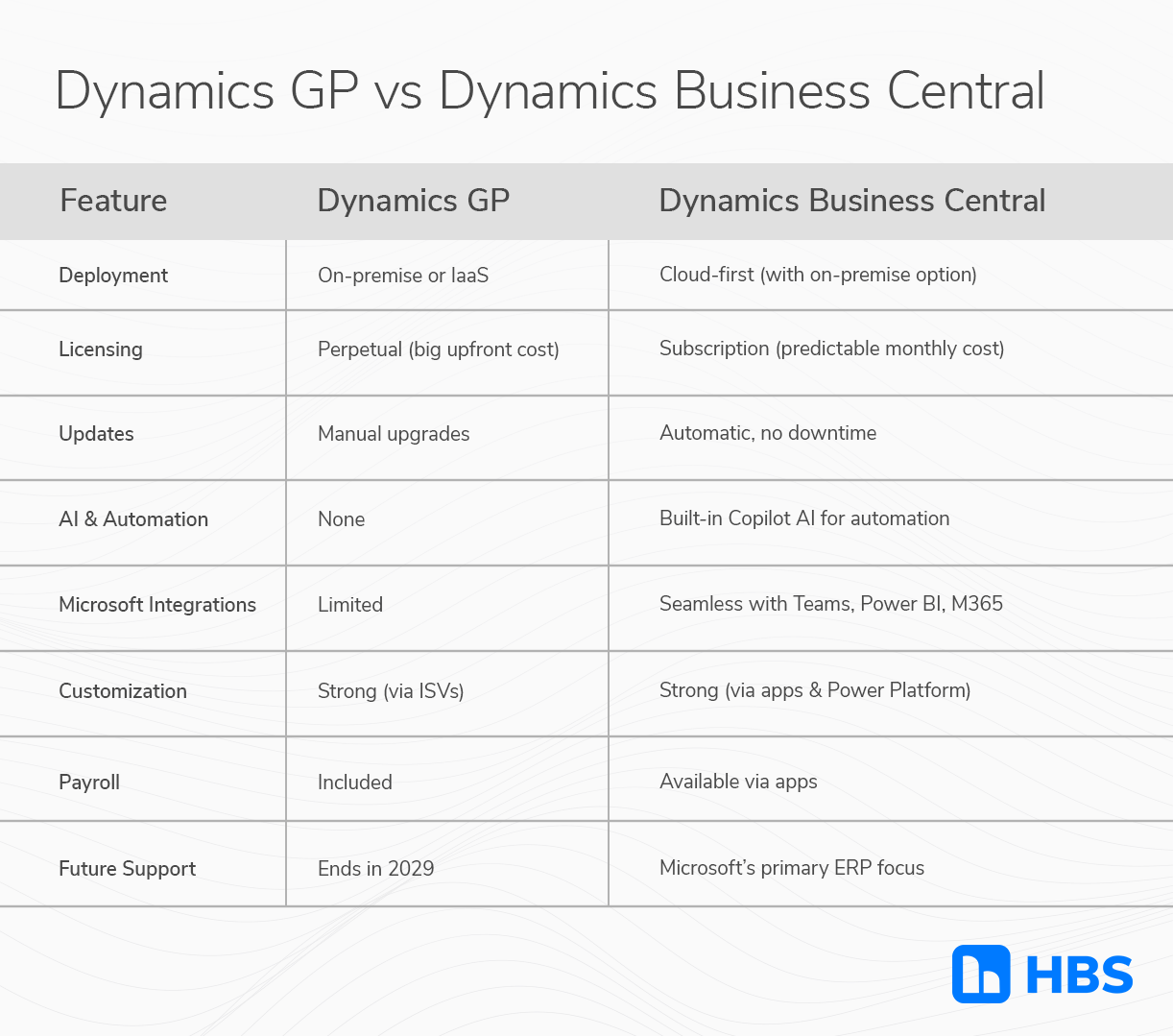
Key Differences: GP vs Business Central

Dynamics GP vs Dynamics Business Central comparison chart

Dynamics GP vs Dynamics Business Central Pricing

When it comes to pricing, Dynamics GP and Business Central follow different models. GP requires a significant upfront investment—new GP licenses are not currently being sold—while Business Central operates on a subscription model with more predictable costs.

Dynamics GP Pricing

  • Additional Full Users: $3,000 one-time fee

Business Central Pricing

  • Essentials Package: $840 per user annually
  • Additional Business Users: $70 per user per month

Choosing between the two involves evaluating not only feature sets but also budget and operational flexibility. Consulting with a Microsoft partner like HBS can help you optimize your licensing, getting the most out of your Microsoft investment.

Why GP Users Are Moving to Business Central

  1. Microsoft’s Priorities Have Shifted
    GP is in maintenance mode. Microsoft will stop selling new GP licenses in 2026 and end all support by 2029. Meanwhile, Business Central is evolving fast, with regular updates, AI-powered automation, and deeper integrations across the Microsoft ecosystem.
  2. The Cloud Advantage
    Business Central removes the hassle of managing servers, upgrades, and security patches. It’s hosted in Microsoft Azure, meaning higher security, better uptime, and no costly hardware refreshes.
  3. More Features, Less Effort
    Business Central simplifies operations with AI-driven insights, automated reporting, and easy collaboration with Teams and Outlook. It also introduces dimensional accounting, a major addition for financial reporting and analysis.
  4. Predictable Costs
    With GP, businesses face large upfront costs and ongoing maintenance fees. Business Central offers flexible, subscription-based pricing, so you only pay for what you need.

Is Business Central Right for Your Business?

  • If you want to future-proof your ERP → Move to Business Central.
  • If you prefer predictable costs and automatic updates → Move to Business Central.
  • If you rely on deep GP customizations → Evaluate Business Central’s app ecosystem.

Many of the add-on solutions you are using in Dynamics GP are ERP agnostic, meaning they can work with any ERP system—e.g. PowerBI, DocLink, Jet Reports, and others. Others are available in Microsoft AppSource, an extensive marketplace for Business Central extensions, offering both free and paid solutions.

Additionally, Business Central includes built-in features—such as dimensional accounting, EFT, AP automation, and bank reconciliation—that may replace some existing add-ons. Before migrating, you should assess what you use now, explore available Business Central apps, and determine whether process changes could enhance efficiency.

1.1 - Overview - 768x432

Making the Transition from GP to Business Central

Migration doesn’t have to be painful. Microsoft offers tools to map GP data to Business Central, and partners like HBS help businesses navigate the transition smoothly.

Final Verdict: The Time to Move Is (Probably) Now


GP has been a solid ERP, but its time is running out. Business Central isn’t just an alternative—it’s the next evolution of Microsoft ERP. Staying on GP too long means higher costs, fewer updates, and falling behind competitors.

Let’s make your move before you’re forced to. HBS can help with your transition to Business Central—reach out to explore your options today.

Related Content

Microsoft Dynamics 365 Business Central

Dynamics 365 Business Central

Streamline operations with a custom Dynamics 365 Business Central implementation from HBS — an ERP solution with ongoing support, training, and optimization.
Learn More »

Want to Move from Dynamics GP to Dynamics 365 Business Central?

If you’re looking to migrate from Dynamics GP to Dynamics 365 Business Central, there are a few things to help with that process.
Read More »
The text "Dynamics Pricing Upcoming Increases: What to Know" on a white and grey textured background. The purple Microsoft Dynamics logo is featured in the bottom right of the image.

Dynamics Pricing Update: What to Know

Dynamics 365 prices will increase starting Oct. 1, 2024. Learn about the pricing details, why this is happening, and how to prepare. HBS is here to help.

Explore More »
  • Dynamics 365, End of Life Software, ERP, Microsoft
Blog

Connect:

[email protected]  |  800.236.7914

HBS logo

HQ | 1700 Stephen Street
Little Chute, WI 54140
Locations

HBS Remote Support | Service & Technical Support | E-Bill Portal
Terms & Conditions | Cookie Policy | Privacy Policy | Onboarding Form | End User Agreements | E-Bill FAQ | Site Map
©2026 Heartland Business Systems. All rights reserved.

Halo from HBS
This chat may be recorded as described in our Privacy Policy.