



 The artificial intelligence (AI) revolution is in full swing. From the quick adoption of large language models like ChatGPT—the fastest-growing user base in internet history—to Nvidia’s unbelievable stock skyrocket
on the back of soaring demand for their GPUs, the world is embracing AI like few innovations before.
Maybe your organization is among the 56% of US companies that are actively using AI to improve business operations, or the 35% leveraging AI for content production.
Or maybe you haven’t dipped a toe into the AI waters at all and don’t know where to begin.
We are just starting to understand AI’s potential to radically change modern work, not only as an efficiency tool but also as a catalyst for expanding business and human potential.
For technology executives, the focus should be clear: leverage AI to enhance productivity, foster creativity, and drive significant business growth.
Let’s explore how.
Step 1: Become an AI Whisperer (Educate Yourself)
You can’t just deploy AI and hope for the best. Understanding the strengths and limitations of AI is critical to unlocking its potential. Here are some ways to educate yourself and your team: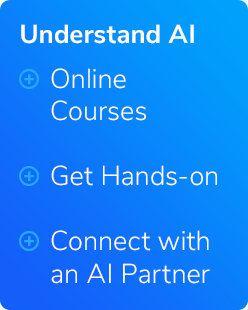
- Dive into Online Courses: Platforms like Coursera, edX and Udacity offer a wealth of AI courses for all levels. Microsoft has invested heavily in its AI product, Microsoft 365 Copilot, and Microsoft wants nothing more than for users to know everything it can do. We recommend starting here.
- Get Hands-On: Learning by doing is powerful. Head over to ChatGPT, Gemini, Copilot and others to explore ways to prompt these tools and get the most out of their capabilities. Look at Azure AI Search to see how data retrieval can be improved with better relevancy, personalization, and pinpoint precision.
- Connect with an AI Partner: Partnering with experts like the team at HBS can unlock a wealth of benefits for you and your organization through customized learning, deep expertise, and future-proofing your AI strategy.
The key is to be proactive. Whether that’s online courses, experimenting with AI Tools, or partnering with an AI expert, you’ll empower yourself—and, by extension, your team—to be ready for AI.
Step 2: Identify AI Opportunities Within Your Organization
Now that you’ve familiarized yourself with AI, it’s time to get specific. This step involves identifying areas within your business where you can generate real value using AI.
While brainstorming, prioritize areas where AI can improve efficiency and productivity, reduce costs, enhance your customer’s experience, and generate new revenue streams.
Here’s a framework to help guide you:
- Look for Repetitive and Rules-Based Tasks: Identify tasks that are manual, repetitive, and follow clear rules. These are prime candidates for automation using AI.
- Examples: Data entry, scheduling appointments, generating reports, processing invoices
- Leverage AI for Data Analysis and Insights:
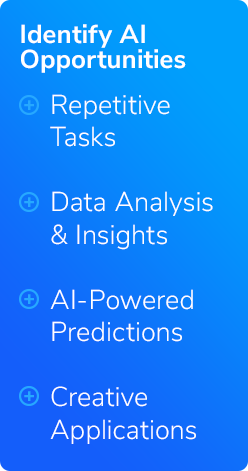 Look for areas where your organization generates a large volume of data. AI is adept at analyzing data to extract insights that may be missed by humans.
- Examples: Customer relationship management (CRM) data for improved customer segmentation and marketing campaigns, sales data for identifying leads and predicting sales trends.
- Enhance Decision-Making with AI-Powered Predictions: Identify areas where better decision-making can significantly impact your business. AI can analyze historical data and identify patterns to predict future outcomes.
- Examples: Predicting inventory needs to optimize stock management, identifying potential equipment failures in a manufacturing setting.
- Explore AI for Creative Applications: Don’t limit yourself to just automation and analytics. Dig into how AI can be used for creative applications within your industry.
- Examples: Generating new product ideas, AI-powered chatbots for improved customer service interactions, and personalized content creation based on user preferences.
Step 3: Address AI Anxieties
 Even the mention of AI in the workplace can stir a mix of emotions among employees, from excitement to apprehension. Your role is to harness these emotions constructively. Start by positioning AI as an ally in the workplace that elevates rather than diminishes human capability.
This begins with clear communication:
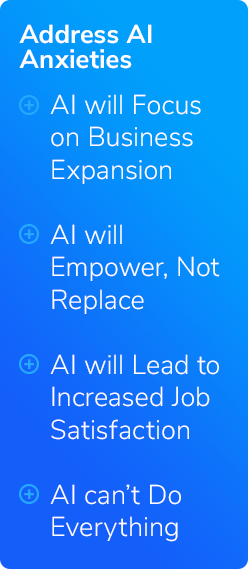
- Highlight AI's Role in Business Expansion: Stress that AI is intended to unlock new opportunities, not cut jobs. 89% of employees who use AI tools feel fulfilled and focused on the work that matters most.
- Assign AI to Mundane Tasks: Let AI handle repetitive tasks, freeing up your team to engage in more meaningful and satisfying work. AI is not here to replace your workforce but to empower it.
- Open Dialogues About Job Satisfaction: Discuss with your team how AI can take on less desired tasks, increasing workplace satisfaction.
- Set Realistic Expectations: Educate your team on the realistic capabilities and growth trajectory of AI, demystifying fears of obsolescence.
Step 4: Establish an AI Policy
Taking the time to think about and establish a clear AI use policy is a crucial part of your AI preparedness. Here’s why:
- Transparency and Trust: An AI policy fosters
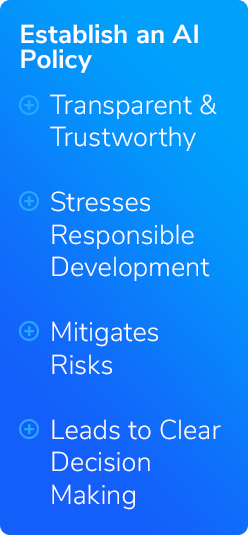 trust by clearly outlining expectations for AI development, deployment and use. It ensures everyone's on the same page, from developers to executives to end users.
 - Responsible AI Development: Your policy should address data privacy, bias mitigation and ethical considerations. This ensures your AI is developed and used responsibly, aligning with your organization's values.
- Risk Management: A well-defined policy helps identify and mitigate potential risks. It could address issues like security vulnerabilities or unintended consequences of AI decisions.
- Clear Decision-Making: The policy should establish clear protocols for AI decision-making. Who has the authority to approve AI projects? What are the criteria for success? This avoids confusion and fosters a more efficient AI integration process.
- Adaptability and Future-Proofing:The AI landscape is constantly evolving. Your policy should be a living document. Review and update it regularly to reflect new developments and address emerging challenges.
By taking the time to set the rules of the game, you'll ensure a smooth, responsible and successful AI integration within your organization. This lays the groundwork for a future powered by innovation and ethical technology.
Step 5: Optimize Your Data for AI
Just like a race car needs high-octane fuel to perform at its peak, your AI initiatives require clean, organized and accessible data.
Here's how to optimize your data for maximum AI impact:
- Tidy Up Your Data Act: AI isn't a magician and
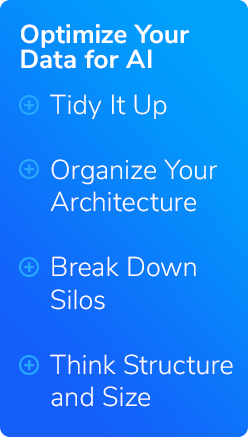 can't work miracles with messy data. In fact, “dirty data” will inevitably lead to bad results. Invest in data-cleaning processes to address inconsistencies, missing values and duplicates. The cleaner your organizational data is, the better your AI will perform.
 - Organize Your Data Architecture: Ensure your data is well structured and accessible. This could involve implementing a data lake or warehouse to centralize and organize your information.
- Break Down Data Silos: Data often gets trapped in departmental silos, hindering AI's ability to see the bigger picture. Break down these silos by fostering collaboration between departments and ensuring all relevant data is accessible for AI analysis.
- Think Structure, Not Just Size:While big data is often associated with AI, it's not just about quantity. The structure and organization of your data are equally important. Well-structured data allows AI to extract more precise insights and make more accurate predictions.
By optimizing your data, you're getting a significant jump on preparing for AI and your future AI implementation. Clean, organized data fuels your AI engine, enabling it to generate sharper insights. And that leads to more intelligent business decisions and a competitive edge.
You Don’t Have to Prepare Alone
All of this may sound like a lot to take on. The good news is that expert help is available. A partner like HBS provides the expertise needed for AI education, training, strategy development, and implementation. From initial AI integration to advanced AI-driven innovations, here's how HBS can empower your AI journey:
- Chart Your Course with Custom Solutions: HBS doesn't offer a one-size-fits-all approach. We work with you to develop AI strategies tailored to your specific business needs and goals. No cookie-cutter solutions, just customized roadmaps to AI success.
- Bridge the Readiness Gap: Not every organization is created equal regarding HBS can help assess your AI readiness and guide you through necessary enhancements, ensuring a smooth and successful integration.
- Your Long-Term AI Ally: The world of AI is new and changing drastically every day. Partnering with HBS means you have access to ongoing support and updates as AI technologies and your business needs change.
The time to prepare for AI is now. Don't be a passive observer. Become a leader in the AI revolution and unlock the full potential of this transformative technology within your organization.
Contact HBS today, and let's discuss how we can help you master AI and revolutionize your business for the future of work.
How to Have AI-Ready Data
Learn how to prepare your data for AI success with key strategies in data hygiene, collection, cleaning, and optimization.
AI Readiness Assessment
Free AI Readiness Assessment. Spend 5 minutes, get an individualized AI Readiness Report with simple next steps to get started.
AI Governance for Trustworthy AI Deployment
Unleash AI’s potential responsibly. Learn what AI Governance is, why it’s crucial, and how you can implement it.