


At first glance, managed XDR will probably seem like a cost increase from your current security solution. But after a closer look, most of our clients find that managed XDR produces cost advantages and workload reductions that easily offset any additional investment you’ll make. In this blog, we highlight key ways that managed XDR makes good business sense, not only by improving your security posture, but by actually saving you money. Use this list to help convince executives that your managed XDR plan makes sense for the budget.
Managed XDR provides a next-gen response to the cybersecurity headlines of the last couple of years. Traditional tools are getting passed up by ransomware innovations, software supply chain attacks and fileless malware. Managed XDR can intercept threats so new that antivirus programs and whitelists don’t even know about them.
A managed XDR solution uses AI, machine learning and global threat reports to block attacks no one has seen before. Whether this is your first event monitoring solution or an upgrade to your traditional SIEM, you’ll run a lot of numbers in deciding what direction to take.
You’ll see that managed XDR goes far beyond keeping hackers out of your system. With HBS tuning the system, managed XDR delivers cost advantages by freeing up staff time, optimizing tools you’re already paying for and more.
Defense Against Zero-Day Attacks
If your cybersecurity program stops only known threats, innovative hackers may feast on your system. This year, for example, has brought a boom in attack vectors such as supply chain attacks and fileless malware that leverage sources you trust (such as software partners and your own operating systems) to compromise your system. XDR provides the protection required in a world hackers are running attacks that have no files to watch for, rendering antivirus solutions defenseless in many cases.
The business advantage: Defenses that constantly adapt to the latest threats.
No More Security Gaps
Most security stacks evolve over time into a mixed bag of platforms from multiple vendors. That creates gaps that attackers can slip through. A managed XDR solution, on the other hand, offers one SOC managing one platform from one vendor. (HBS uses Microsoft’s Azure Sentinel and Defender for Endpoint.) With a unified managed XDR platform, you get native integration of SIEM, endpoint protection, vulnerability scanning, antivirus and more. That eliminates cracks that weaken most multivendor systems.
The business advantage: Elimination of gaps that could render your security stack ineffective.
Actionable Alerts
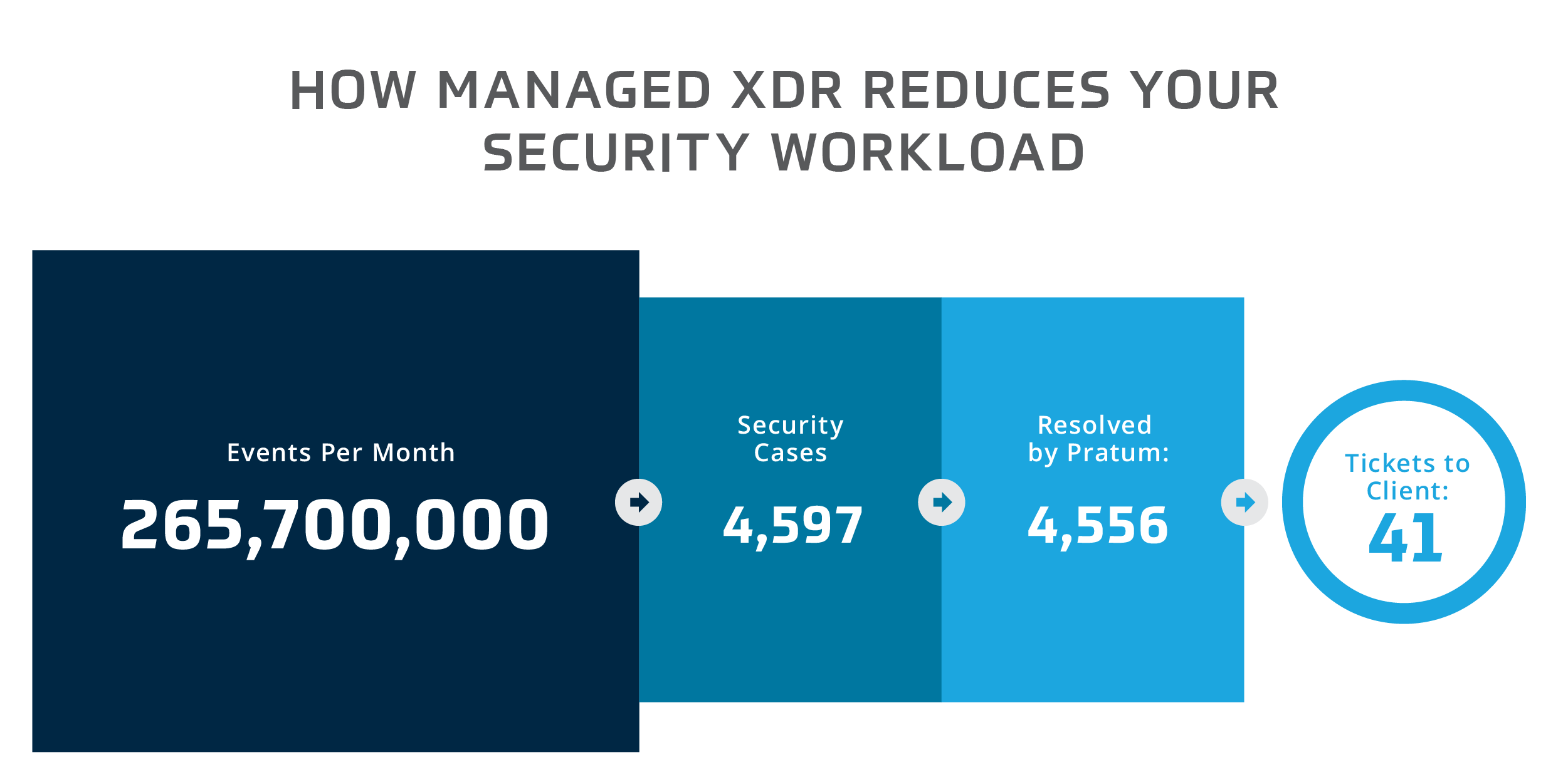
Our incident alerts provide critical detail and context that let you drill down on specific improvements for your security program. The chart shown here illustrates how HBS uses Azure Sentinel to dramatically reduce the number of alerts a client’s IT team would normally have to manage.
Most of the tickets that make it to the IT team require only a simple response to a question such as, “Was the addition of user ‘larrybird’ to AdminGroup a legitimate request?” Other alerts recommend a specific action such as blocking a specific IP address that is attempting multiple suspicious logins.
The business advantage: More IT efficiency through highly targeted alerts.
Reduced IT Workload
Despite marketing promises from some XDR vendors, XDR is not a plug-and-play tool. So if you’re considering implementing an XDR platform through your current IT team, make a careful review of what that will require. These advanced systems require regular fine-tuning for your environment to reach the full value you’re paying for. By managing your XDR system, HBS’s SOC frees up your IT team to complete other business-critical projects. By minimizing false positives, we limit alerts to the critical events you specifically want to monitor.
The business advantage: Free up your IT team to complete the business-critical projects they were hired to do.
Dramatically Lower Downtime
Most breaches take days or weeks to discover. So the minute that you realize your system has been breached, you’re already behind. That makes timely digital forensics work a top priority. With 24/7 monitoring of your entire system and advanced threat hunting offered by managed XDR, you can typically reduce forensics analysis of attacks from days to minutes. That means you catch and eradicate intruders faster.
The business advantage: Business interruptions reduced to hours rather than days.
Strategic Guidance
When HBS’s SOC analysts implement a new managed XDR relationship, they lead provisioning, rule creation and more. We work every day with multiple industries and dozens of clients—and apply the lessons to your XDR setup. Every lesson learned by Microsoft and HBS improves your system.
The business advantage: Best practices gleaned from dozens of other XDR installations.
Better Results From Your Other Tools
Managed XDR monitors the effectiveness of security layers throughout your system. For example, if you have an e-mail filtering solution that isn’t stopping spam sufficiently, XDR lets you know. Sometimes, we’ll determine that XDR can actually replace tools, reducing your IT expense.
The business advantage: Full value from the tools you’re already paying for.
If you’re ready for a free consultation on how managed XDR can boost your bottom line, contact HBS today.
Beyond SIEM: How XDR Maximizes Threat Detection and Response
Discover how XDR overcomes the limitations of traditional security monitoring tools and provides a more robust approach to threat detection and response.
Managed XDR
Enhance security with Managed XDR from HBS: 24x7x365 SOC support, leveraging Microsoft Sentinel & Defender for proactive, adaptive threat defense and response.
How Managed XDR Makes the Most of the Latest Endpoint Protection Tools
Managed XDR helps endpoint detection reach its full threat-hunting potential as human experts tune the rules for ever-changing situations.